
One ear piercing is simple. Two starts to feel intentional. Three, four, or five? Now you're building a whole damn composition.
That's the idea behind ear stacking: combining multiple ear piercings and jewelry pieces so they work together instead of looking like a random pile of metal. And the best stacks don't necessarily use the most jewelry—they use the right jewelry in the right places.
Whether you're starting with a single lobe piercing or already have enough holes to make airport security nervous, this guide breaks down how to style multiple ear piercings without overcomplicating it.
You've got one or two piercings and want to build something intentional. You need a plan that considers anatomy, placement spacing, and how future piercings will work together.
You've collected piercings over time but they don't feel cohesive. You want to learn how jewelry choices, metal mixing, focal points, and negative space can turn what you have into a curated stack.
You're happy with what you have but considering one more. You need to understand how placement, scale, and balance shift when you add another piece to the composition.
Ear stacking is the practice of arranging multiple piercings and jewelry pieces across the ear to create a coordinated look.
That might include:
Some stacks are clean and minimal. Others mix hoops, chains, gems, bold shapes, and different textures. There isn't one correct formula.
The goal is to make the whole ear feel intentional.
💡 Helpful Resource: If you're still figuring out which placements are even possible, our breakdown of common ear piercing locations is a good place to start before planning the full stack.
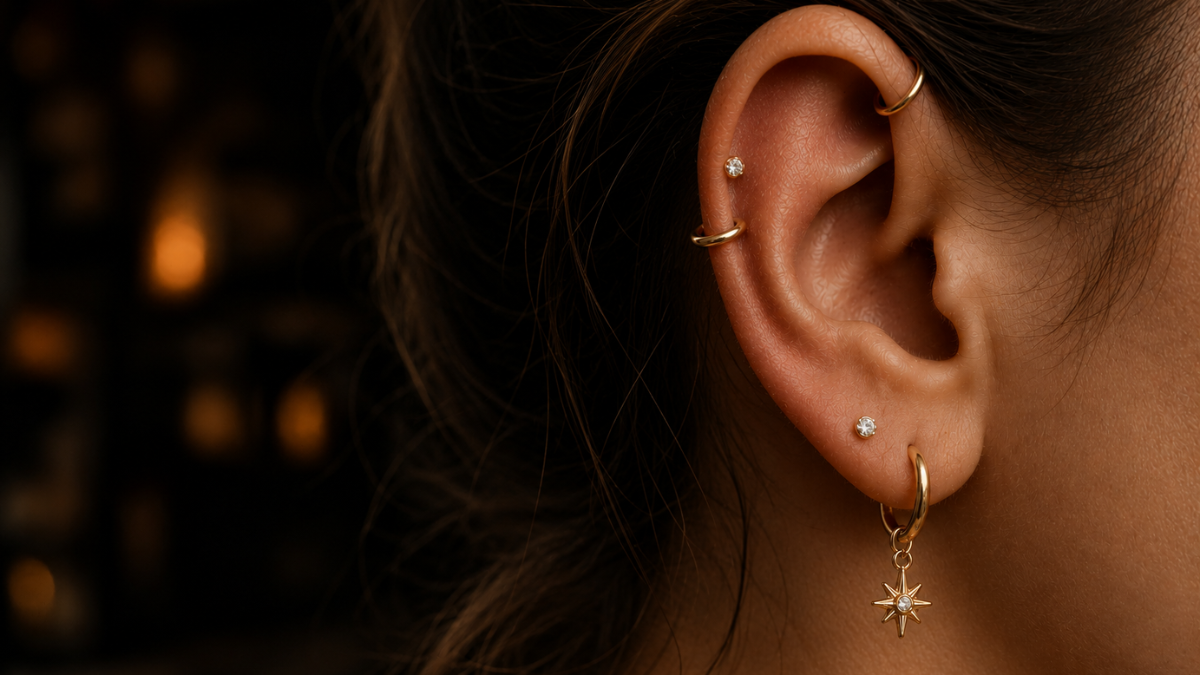
Here's the first rule of ear styling:
Your ear anatomy matters.
A stack that looks perfect on somebody else may not translate directly to your ear because the shape, folds, available space, and cartilage structure are different.
That matters especially for piercings like:
Some people simply have more room for certain piercings than others.
That doesn't mean your ear is "wrong." It just means the best stack is the one designed around the anatomy you actually have.
Bring inspiration photos if you want. They're useful. Just treat them as a starting point, not blueprints.
If you're new to ear stacking, the lobe is usually the easiest place to start visually.
A classic stack might include:
That gives you a natural visual progression from larger jewelry at the bottom to smaller pieces higher up.
Example progression:
First lobe: Bold hoop or larger stud
Second lobe: Smaller gem or decorative stud
Third lobe: Tiny accent piece
Helix: Small hoop or simple stud
You don't have to follow that pattern exactly, but gradually reducing scale often helps a stack feel balanced.
A stack made entirely of identical studs can look clean. A stack made entirely of hoops can look bold.
But mixing the two usually creates more movement and contrast.
Try combinations like:
The contrast between shapes is what keeps the ear interesting. Think of it less like matching every piece and more like building a good outfit. Everything should make sense together without looking like it came in one boxed set.
One of the easiest ways to avoid overcrowding is to pick one piercing or jewelry piece to carry the most visual weight.
Maybe it's:
Then let the rest of the jewelry support it.
If every single piercing is trying to be the main character, the stack can get noisy fast. A strong focal point gives your eye somewhere to land.
Not every piece should be the same size. That's especially true when you have several piercings sitting close together.
For example, three lobe piercings might look great with:
That creates rhythm.
On the other hand, three oversized pieces crammed into the same section can compete for space and make the ear feel heavier than intended.
Small jewelry doesn't mean boring. A tiny gem, star, spike, disc, or bead can add just enough detail without taking over.
You don't have to wear one metal forever. Gold, silver-toned jewelry, black finishes, gems, and mixed-metal combinations can all work.
But mixing metals tends to look best when it feels deliberate.
✓ Mostly gold with one silver-toned accent
✓ Silver-toned jewelry with a black statement piece
✓ Matching metal throughout but different gemstones
✓ Two metals repeated in several places instead of appearing once at random
You can absolutely break the "rules." Just make it look like you meant to.
One of the biggest mistakes in ear stacking is thinking every open spot needs a piercing.
It doesn't.
Empty space is part of the design. If every section of the ear is filled, individual jewelry pieces can disappear into the clutter.
Leaving some breathing room helps highlight the piercings you do have.
This is especially useful when you have strong placements like a conch, flat, or helix that deserve some visual space around them.
Pro tip: Sometimes the move isn't adding another piercing. Sometimes it's upgrading the jewelry in the ones you already have.
If you want something clean and easy to wear every day, keep the shapes simple.
A minimalist stack might include:
That's it.
Minimalist styling tends to rely more on spacing, proportion, and placement than ornate jewelry. The trick is making each piece earn its spot.
If subtle isn't your thing, good. Go louder.
A bolder stack could combine:
The key is still balance. Bold doesn't have to mean throwing everything in the jewelry case onto one ear.
Pick two or three strong elements and use smaller pieces to tie them together.
Your ears do not have to match.
Actually, asymmetry can make the whole look much more interesting.
One ear might have:
While the other has:
You can still keep them visually connected by repeating:
The ears work as a pair without becoming copies of each other.
Ear stacking gets better when you stop thinking one piercing at a time.
If you know you eventually want a curated ear with several placements, tell your piercer.
That can affect where the first few piercings go.
For example:
Good planning gives you options.
And you don't have to build the entire stack in one visit. In fact, letting your piercings heal properly before piling on more can make the whole process easier.
⚠️ Don't rush the healing just for the look: Fresh piercings need time. Initial jewelry is chosen with healing, swelling, and anatomy in mind. Once appropriately healed, you may have more styling options. If you're wondering why certain materials are preferred or why jewelry size matters, our guide to piercing jewelry materials and sizing breaks down what actually matters beyond appearance.
There isn't one perfect answer, but a good ear stack often includes a mix of:
Popular for many ear placements because they can create a clean profile without a traditional earring back sticking out behind the ear.
Great for adding shape and movement, especially in healed lobe, helix, or conch placements when suitable for that specific piercing.
Useful for creating small focal points without making the stack feel bulky.
Chains can add movement and connect different parts of a curated ear, but they're generally something to consider once compatible piercings are well healed.
Sometimes the simplest piece is exactly what keeps a complicated stack from becoming too much.
The right jewelry depends on the placement, stage of healing, anatomy, and overall look you're going for.
Nope. There's no scoreboard.
One ear can have six piercings while the other has two.
You can make one side loud and keep the other clean. What matters is whether the overall styling feels right to you.
Some people prefer symmetry. Some want organized chaos. Both work.
You can absolutely plan the look at once.
Getting every piercing at once is another story.
Your piercer may recommend spacing the process out based on:
Healing multiple cartilage piercings at the same time can require more patience than people expect.
So dream big. Then build smart.
Need somewhere to start? Here are a few combinations worth talking through with a piercer:
Ear One: Three lobes + helix
Ear Two: Two lobes + conch + flat
Use these as inspiration, not rules. The best configuration is the one that works with your ear anatomy and your style.
A good ear stack shouldn't look like you copied somebody else's ear pixel for pixel.
It should feel collected. Built over time.
Maybe one piercing marks your freshman year in Athens. Another was spontaneous. Another finally gave you the balance you'd been trying to get for months.
That's what makes it interesting.
At Curly's Tattoo Parlor, you can explore piercing options available at the shop and talk through placement, jewelry, and how future piercings could fit into the bigger picture.
For more straight answers about jewelry, healing, and different placements, browse our Piercing Info guides.
And if you've already got three screenshots and absolutely no idea how to turn them into one ear, get in touch with Curly's and bring the inspiration with you.
We'll help you figure out what works on your ear.
No copy-and-paste bullshit required.
Ear stacking is the practice of arranging multiple piercings and jewelry pieces across the ear to create a coordinated look. This might include multiple lobe piercings, helix, flat, tragus, conch, forward helix, rook, daith, and other cartilage placements. The goal is to make the whole ear feel intentional rather than random.
No. One ear can have six piercings while the other has two. You can make one side loud and keep the other clean. What matters is whether the overall styling feels right to you. Some people prefer symmetry, while others want organized asymmetry. Both work.
A good ear stack often includes a mix of flat-back studs, small hoops, gem or decorative ends, chains (once healed), and simple beads or discs. The key is mixing studs and hoops for contrast, varying jewelry sizes, choosing one focal point, and using negative space intentionally rather than filling every available spot.
While you can plan the entire look at once, getting every piercing simultaneously is different. Your piercer may recommend spacing the process out based on how many piercings you want, where they're placed, how they're likely to heal, and how much aftercare you can realistically handle. Healing multiple cartilage piercings at the same time requires more patience than people expect.
Your ear anatomy determines what piercings are possible and how they'll look together. The shape, folds, available space, and cartilage structure vary between people. Piercings like rook, daith, forward helix, flat, snug, and certain conch placements depend heavily on individual anatomy. The best stack is designed around the ear you actually have, not someone else's Pinterest photo.
Neither is "better." Minimalist stacks rely on clean shapes, intentional spacing, and subtle focal points. Bold stacks use more piercings, mixed jewelry types, and stronger visual elements. What matters is which approach fits your style and anatomy. Both can look equally intentional when done right.
Yes. Mixing metals can work when it's done deliberately. For example, mostly gold with one silver accent, or silver throughout with a black statement piece. What tends to look less intentional is randomly mixing metals with no repetition. If you're going to mix, make it look like you meant to.
When the ear feels balanced and every piece has room to be noticed. If you're starting to fill every available space just because it's there, that's usually a sign to pause. Good stacks use negative space intentionally. Sometimes upgrading the jewelry you already have is a better move than adding another piercing.
Whether you're starting from scratch or reworking what you've already got, we'll help you figure out what works with your anatomy, your style, and your long-term vision.
Bring your inspiration. We'll bring the straight answers.
Book a SessionNo pressure. No pitch. Just real talk about what'll actually look good on your ear.


