You've got a meaningful symbol in mind, a few saved photos on your phone, and maybe a rough sketch or two. None of it looks like a finished tattoo yet, and that's perfectly fine. Most people walking into a tattoo shop aren't carrying a portfolio-ready piece of artwork. They're carrying an idea that matters to them and need an artist to help turn it into something that works on skin.
Developing a tattoo design means identifying the core concept, choosing visual references, selecting a style, considering size and placement, and working with an artist to refine the composition. It's a collaborative process where your vision meets technical reality.
Here's how that process actually works, from rough idea to tattoo-ready artwork.
First-Timer With a Story
You've got a meaningful memory, symbol, or milestone you want represented. You don't know what style or size works, but you know what it needs to say.
Visual Collector
You've saved a dozen different reference images but can't quite see how they all come together. You need someone to translate inspiration into cohesive artwork.
Concept Builder
You want something custom that combines several elements. You're not sure if it's too complicated or how to balance all the pieces without making it crowded.
You don't need to show up with a polished illustration. You need to understand what the tattoo is supposed to communicate.
Start by identifying the main subject. A rose? A compass? A landscape? A portrait? Then think about the one or two essential elements that make it personal. Maybe it's a specific flower variety that reminds you of your grandmother. Maybe it's mountains from a trip that changed your life. Maybe it's just a skull because you think skulls look badass.
Separate the meaningful details from the decorative extras. Not every concept needs deep symbolism. A visually striking snake, dagger, eagle, or traditional flash-inspired design is just as valid as a memorial piece. What matters is knowing which parts are non-negotiable and which parts you're open to adjusting.
Let's say you want a rose tattoo to honor your grandparent. You might know the specific flower variety, a meaningful date you want included, or whether you prefer bold traditional linework or softer black-and-gray shading. You don't need to know the exact petal arrangement, stem angle, or background composition. That's where the artist comes in.
You need to understand what matters in the concept. You don't need to know how to draw it.
Words can only get you so far. A focused selection of reference images helps your artist understand the visual direction you're aiming for.
Bring a handful of images that show what you're drawn to. Explain what you like about each one. Maybe you love the composition in one photo, the bold outlines in another, and the shading style in a third. Include personal photographs or your own rough sketches when they're relevant. Point out elements you definitely don't want, too.
Here's the important part: references are starting points, not instructions to reproduce another person's tattoo.
A photograph, digital illustration, or existing tattoo might contain details that need to be simplified, rearranged, or adapted before they'll work on skin. Fine lines that look crisp in a photo can blur over time. Complex patterns that work at poster size can turn muddy when shrunk down to forearm dimensions. Background elements that frame a digital illustration might compete with the main subject when tattooed.
Say you like the flower arrangement from one image, the bold outlines of another, and the shading from a third. A good artist can use those preferences to develop an original composition rather than copying an existing piece. That's what turns scattered inspiration into a cohesive custom design.
⚠ Don't Do This: Don't bring two dozen unrelated screenshots and expect an artist to replicate someone else's custom tattoo exactly. That's not collaboration—that's asking someone to trace another artist's work.
This is where the magic happens. An artist doesn't just reproduce what you show them. They interpret, compose, refine, and adapt your concept into something that works as a tattoo.
Here's what that process looks like:
1. Interpretation: The artist identifies the main subject and the essential features that make it recognizable and meaningful.
2. Composition: Individual elements get arranged into a cohesive visual design. Think hierarchy, balance, flow.
3. Style: Linework, shading, color approach, and overall visual treatment get locked in. American traditional, black-and-gray, fine line—whatever fits the concept.
4. Refinement: Unnecessary details get removed while the meaningful elements stay front and center.
5. Technical Adaptation: The design gets adjusted for size, placement, and long-term readability.
These decisions aren't arbitrary. An artist might enlarge the central subject so it reads clearly from a distance. They might simplify a busy background so it doesn't compete with the focal point. They might separate overlapping elements that would blur together over time. They might recommend a different orientation because the body's natural contours favor horizontal flow over vertical stacking.
Your input and the artist's expertise complement each other. You bring the vision and the meaning. The artist brings the technical knowledge to make it work on skin. At Curly's, that collaboration starts with listening—understanding what the tattoo represents before picking up a pen.
A design that looks great on paper doesn't automatically translate to skin. Bodies aren't flat canvases. Ink spreads slightly over time. Fine details soften. Here's what matters.
Intricate details, tiny lettering, narrow gaps between elements, and highly complex patterns can be tough to preserve at small sizes. A portrait that requires capturing subtle facial features won't work at two inches tall. A mandala with dozens of fine lines might need to be larger than you initially planned, or simplified to maintain clarity.
Simplifying artwork doesn't mean dumbing it down. It means prioritizing the elements that make the design recognizable and removing the ones that will blur into mush. Bold, clean lines and intentional negative space age better than dense, busy compositions.
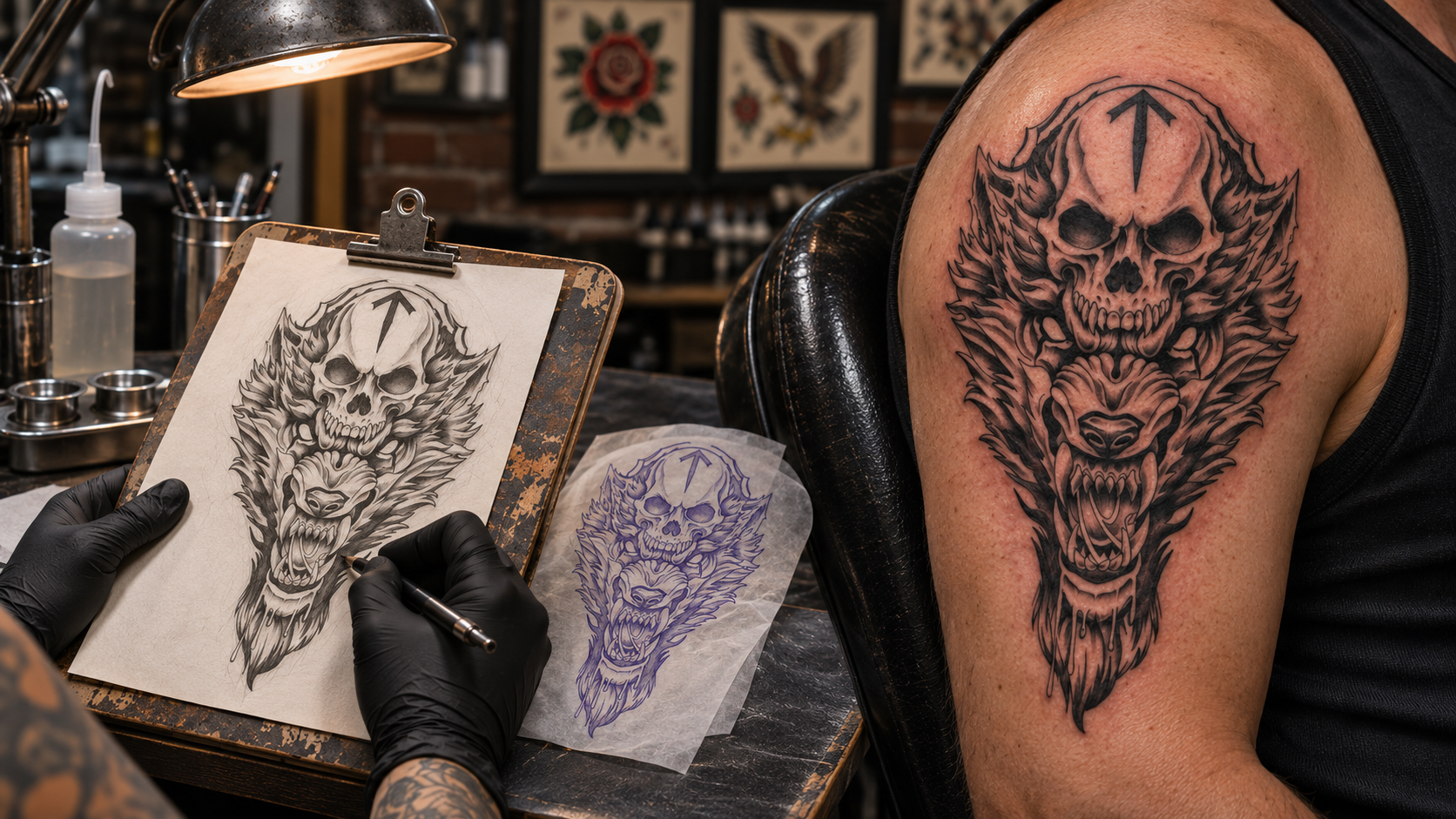
Your body's natural contours influence how a design sits. A piece meant for a forearm might need different proportions when moved to a shoulder, calf, or ribcage. Curved areas require designs that flow with the muscle. Flat areas give you more freedom.
Direction matters too. A vertical design on an arm will be viewed differently than a horizontal one wrapping around the bicep. Artists think about how the tattoo looks from different angles, not just straight-on. Our guide to choosing tattoo placement digs deeper into those considerations.
Bold outlines, strong black-and-gray shading, and deliberate use of negative space all affect how a design holds up. American traditional tattoos use thick outlines and solid color blocks for a reason—they age well. Fine-line work can be stunning but requires more careful execution and realistic expectations about how it will look in ten years.
Neither approach is better. They're different tools for different goals. What matters is choosing a style that suits your concept and understanding the trade-offs.
💡 Pro Tip: A small design with a detailed compass, flowers, a name, and a long quote will need serious simplification, increased size, or a completely revised layout. When in doubt, give the design room to breathe.
You want a compass, mountains, and a rose—all representing different parts of your story. Can it work? Often, yes. But it requires thoughtful composition.
Start by identifying the primary subject. What's the focal point? In this example, maybe it's the compass. The mountains become a supporting element in the background. The rose sits at the base, balancing the composition without competing for attention.
↓ What Keeps It Clean
↑ What Creates Chaos
Sometimes combining ideas means removing details from individual elements. The mountains might become a simplified silhouette. The rose might lose a few petals. Those adjustments aren't compromises—they're what makes the whole design work together.
You're allowed to ask for changes. In fact, you should. The design needs to feel right before it goes on your body.
Be specific about what's bothering you. Not "something feels off"—that doesn't give the artist anything to work with. Instead, point to the actual issue. The flower feels too small compared to the lettering. The compass looks tilted when you want it centered. The shading feels heavier than you expected.
Separate the essential elements from optional preferences. If the rose absolutely has to honor a specific variety, say so. If you just like roses in general and the artist suggests a slightly different petal arrangement for better composition, stay open to it.
When an artist recommends a change, ask why. Usually there's a technical reason—improving readability, balancing the composition, ensuring the design ages well, or making it work better on the chosen body area. Understanding the reasoning helps you make an informed decision.
❌ Vague Feedback
"Something about it looks wrong."
✓ Specific Feedback
"I like the overall composition, but I want the flower to feel more prominent than the lettering."
Respectful feedback is part of collaboration. Clients should feel comfortable raising concerns before approving the final design. From bold traditional pieces to detailed custom artwork, Curly's tattoo services and design options are built on that back-and-forth conversation.
A design is ready when it communicates the main idea, suits the body area, reflects the style you want, and feels right to you.
Ask yourself:
The final stencil placement also matters. Before any ink goes in, you'll review the size and positioning on your actual body. If something feels off at that stage, speak up. Better to adjust the stencil than live with a tattoo that's slightly crooked or an inch too high.
Before settling on a style or finalizing your design direction, take a look at the artists behind Curly's tattoo work to see different creative approaches. And if you want more detail on what happens once the design is locked in, our guide to tattoo consultations covers the next steps.
Yes. A tattoo artist can use your concept, sketches, and reference images to develop original artwork, adjusting the composition, detail, and placement to suit tattooing.
No. A clear description, a few useful references, or a rough sketch can be enough to begin discussing a custom design.
Often, yes. The artist can identify the most important elements and create a balanced composition, although some details may need to be simplified or removed.
The original concept might contain too much detail for the intended size, lack sufficient contrast, or need adjustments to fit the chosen body area.
Yes. Explain the changes you want and why they matter. The artist can help determine which adjustments preserve the concept while remaining practical.
Whether you've got a rough concept, a stack of reference images, or a clear vision that just needs the right artist to execute it, Curly's welcomes all of it. Our crew works across traditional, black-and-gray, and custom styles, and we're here to help you develop an idea that works on skin—not just on paper.
No pressure. No pitch. Just honest conversation about what you want and how to make it happen.
Book a SessionLocated at 955 Danielsville Rd, Athens, GA 30601 | Call (706) 215-9152


