A tattoo doesn't need to cover half your arm to mean something. Some of the best tattoos are the ones you could almost miss at first glance: a tiny symbol tied to someone you love, a few words you've carried with you for years, a piece of old-school flash shrunk down to the essentials, or something weird that makes absolutely no sense to anyone except you.
That's part of what makes small tattoo ideas so damn versatile. They can be bold or quiet. Serious or funny. Visible every day or tucked somewhere only you know about.
If you're trying to figure out what your small tattoo should actually be, don't start by asking what everyone else is getting. Start with what you want the piece to say.
Before you dive into ideas, figure out what kind of statement you're trying to make.
You want something that matters to you, but you're not trying to commit to a massive piece before you know how you feel about the process.
Consider: Minimalist designs, simple traditional flash, a small symbol with personal meaning, or something that works as a standalone piece but could expand later.
You've got a story, a person, or a moment you want to carry with you. The tattoo doesn't need to be obvious to anyone else—it just needs to mean something to you.
Consider: Handwriting, coordinates, dates, small objects tied to a memory, initials, or a symbol that represents someone important.
You already have ink or you know one tattoo is going to turn into five. You're looking for something small that fits into your existing or future collection without taking up premium real estate.
Consider: Flash pieces, traditional imagery, nature elements, or designs that complement your existing work or leave room for future additions.
Here's the thing about small tattoos: smaller doesn't automatically mean simpler to execute.
When you have less space, every line matters. An artist has to think about how much detail will realistically fit, how the design works with the placement, and how readable it will remain as the tattoo settles into your skin.
A strong small tattoo usually has a few things going for it:
Real talk: You don't need some life-changing story behind every tattoo. Sometimes a snake is just a badass snake. But there should be something about the design that makes you want it on your body instead of just saving it to your phone.
American Traditional tattooing is known for bold outlines, recognizable imagery, and designs built to read clearly. That makes plenty of traditional concepts worth considering when you want something relatively compact.
Not trying to cram a full back-piece level of detail into three inches of skin. A good artist can strip an idea down to the elements that matter most while keeping its personality intact.
If that bold, old-school look is your thing, our guide to the staying power of American Traditional tattoos digs deeper into what defines the style and why it has lasted for generations.
Some small tattoos carry a hell of a lot more weight than their size suggests.
Maybe it's:
Here's where the conversation before the tattoo matters:
Say you want a tattoo for your grandfather. You could tattoo his name, sure. But maybe the better design is the pocketknife he always carried, the flower he grew in his backyard, or a simplified version of something he drew.
Meaning doesn't have to be obvious to everybody else. It just has to be yours.
That connection between ink and personal experience goes much deeper in our article about how tattoos turn memories and experiences into visual stories.
Minimalist tattoos usually rely on restraint. Instead of packing in shading, textures, and a bunch of secondary elements, the design uses a smaller number of lines or shapes to communicate the idea.
Skin isn't paper. Extremely tiny details and lines placed very close together may not remain as distinct over time.
Your artist may recommend making the design slightly larger, removing a detail, or changing the placement. That's not them wrecking your idea. That's them trying to make the tattoo work on actual skin.
You don't need a giant realism piece to make black and gray work. Small black-and-gray designs can use linework, contrast, and carefully controlled shading to create something with more depth while staying relatively compact.
It depends heavily on size.
If you bring in a reference packed with tiny textures and shadows but only want the finished tattoo to be an inch wide, expect your artist to talk through what needs to change. Good tattooing isn't about saying yes to every detail. It's about figuring out which details will make the final piece stronger.
Nature gives you a ridiculous number of tattoo ideas without requiring a massive canvas.
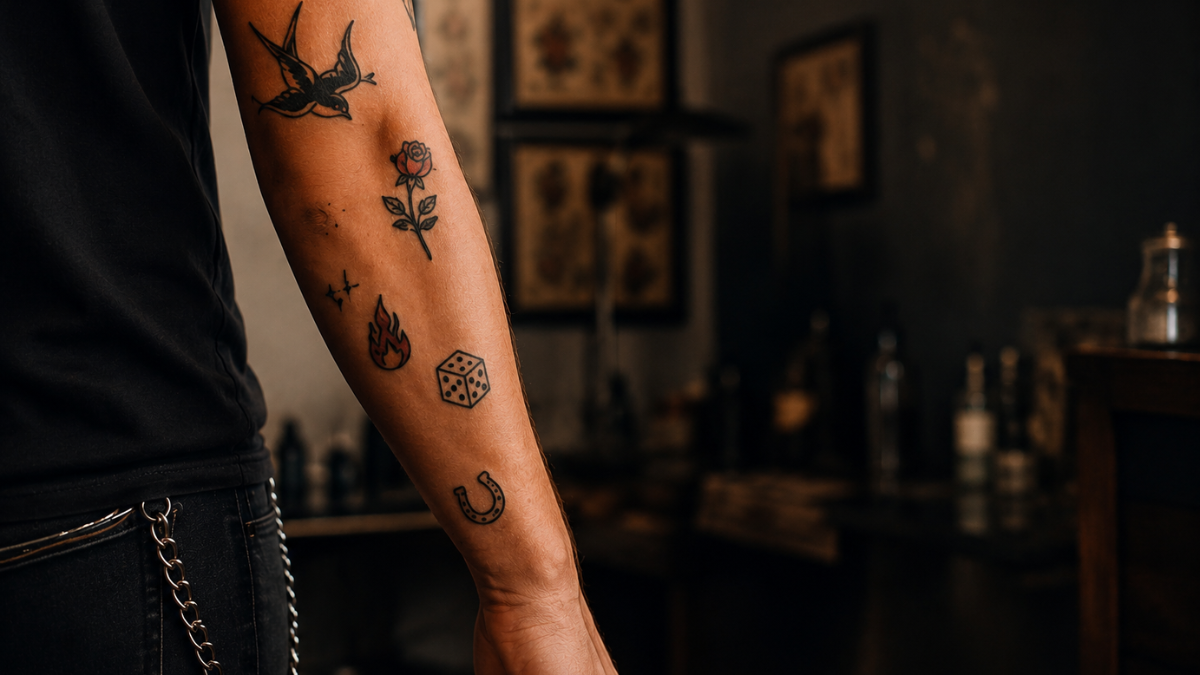
Pro tip: You can change the entire feel of one subject based on the style. A rose can be bold and traditional, delicate and minimal, dark and heavily shaded, or strange and surreal. The subject is only the starting point.
Athens has no shortage of personality. For college students arriving in town, going back to school, graduating, or simply making memories here, a small tattoo can become a marker of a specific chapter without needing to scream "college tattoo."
Athens is the kind of place where different tattoo influences collide—students, longtime locals, artists, musicians, bikers, and people who simply appreciate the craft. That mix is part of what keeps the scene vibrant.
That diversity is part of what keeps Athens' tattoo scene tied to the energy of a college town without making every tattoo about the university.
If you're starting a new semester, you don't need a "back-to-school tattoo." Get something that represents your version of this point in your life.
Matching tattoos don't have to be identical infinity symbols. Friends, siblings, partners, roommates, or family members can start with the same concept and interpret it differently.
The best matching tattoos usually have enough individual personality that each piece still works on its own. Because relationships matter—but you're still the one wearing your tattoo.
Sometimes you don't need an illustration. One word can do the job.
Names, dates, phrases, handwriting, song-related references, nicknames, coordinates, Roman numerals, and personal reminders can all work as smaller tattoos.
Just be careful with size.
Tiny lettering might look crisp on a phone screen or stencil, but letters need enough room to remain readable as the tattoo ages. Your artist can help determine an appropriate size based on the font, placement, number of characters, and complexity.
If keeping it readable means going a little bigger than you originally imagined, that's usually a worthwhile trade.
Placement can completely change how a small tattoo feels.
Easy to see, plenty of relatively flat space, and useful if you think you might eventually add more tattoos around it.
A versatile spot if you want the option to show or cover your tattoo depending on what you're wearing.
Great for simple concepts, although available space limits how detailed you can go.
A popular choice for compact designs and pieces you don't necessarily want front and center all day.
Provides more room than people sometimes realize and can work well for designs with a little movement.
Another flexible area that gives your artist room to work without making the tattoo overwhelmingly large.
Useful if you want something more private, although comfort during the tattoo is another conversation entirely.
Before choosing based purely on aesthetics, think about visibility, pain tolerance, your job or lifestyle, sun exposure, and whether you might want additional tattoos nearby later.
Absolutely. That tiny tattoo on your forearm today could eventually sit alongside several other pieces. Or it could stay completely by itself.
Neither option is wrong.
If you already suspect that one tattoo is going to turn into five, tell your artist. Placement can be planned so you aren't unnecessarily boxing yourself out of good space for future work.
You don't need to design your entire body ten years in advance. Just give the future version of yourself some options.
There isn't one universal minimum size for every tattoo. A tiny solid heart and a detailed wolf head are completely different problems. What matters is how much information the design contains and whether that information has enough space to remain readable.
This is where Pinterest, Instagram, and heavily edited tattoo photos can create unrealistic expectations. You might walk in wanting something one inch wide. After seeing the reference, your artist might recommend two or three inches instead. Hear them out. Making a tattoo slightly larger isn't automatically an upsell. Sometimes it's simply what the design needs.
Not necessarily—but they may be over faster. Pain depends heavily on placement, your individual tolerance, and what the artist needs to do.
A 20-minute tattoo on a sensitive spot can still sting like hell. A small tattoo on an easier area may feel completely manageable.
If pain is one of the main reasons you're leaning toward something small, placement is worth discussing with your artist before committing to the design.
They can be. A small tattoo lets you experience the process without committing to a multi-hour session or a huge portion of your body.
But don't choose a design you don't really want just because it seems like a "safe first tattoo." Your first tattoo doesn't need to be tiny. And your small tattoo doesn't need to be your first.
Pick the piece because you actually want to wear it.
That depends on the design, placement, and how well it's executed. Tattoos naturally settle and soften as your skin ages and moves. Some designs age better than others.
Bold, clean lines with adequate spacing tend to hold up better than extremely fine details packed closely together. Your artist can help determine whether a design will realistically maintain its clarity at the size you want.
Proper aftercare, sun protection, and skin health also play major roles in how your tattoo looks years down the line.
Absolutely. Bringing multiple references helps your artist understand what elements you're drawn to, what style feels right, and what the overall vibe should be.
Just be clear about what you like in each reference—whether it's the line quality, the composition, the subject matter, or the overall feel. That helps your artist pull the best pieces together into something that actually works for you.
You don't need to walk into a tattoo shop with a finished masterpiece. Bring a screenshot. Bring a sketch. Bring three completely different references. Tell us the story behind the tattoo. Hell, tell us you know the feeling you want but have no idea what the design should be yet.
That's what the conversation is for.
At Curly's Tattoo Parlor, you can check out the tattoo work and styles available at the shop and meet the artists behind the work before deciding who you want to talk with.
Want more straight answers before getting in the chair? Browse our Tattoo Guides for more on styles, placement, preparation, aftercare, and the tattoo process.
Small, big, serious, stupid, sentimental, traditional, weird—we're interested in what makes the tattoo yours.
If you've got an idea bouncing around in your head, get in touch with Curly's Tattoo Parlor or stop by the shop in Athens and talk it through.
Book a SessionZero judgment. Just art.


